
What is a falling block merge game?
A falling block merge game, also called a falling block number puzzle or number block puzzle game, gives you one numbered block at a time. You choose the column, the block falls to the top of that column, and equal numbers that touch merge into one block worth double. A merge can set off the next one, and the game ends when a column is full. Boxes Go Wild is a game of this kind, with numbered crates on a five-column board.
The rules in four lines
- One block per move. The next block waits above the board. Pick a column and it falls there.
- Equal numbers merge. 2 and 2 make 4, 4 and 4 make 8, and so on, with no upper limit.
- Merges chain. The new block may touch another of its new value and merge again.
- A full column ends the game. The score is what your merges earned along the way.
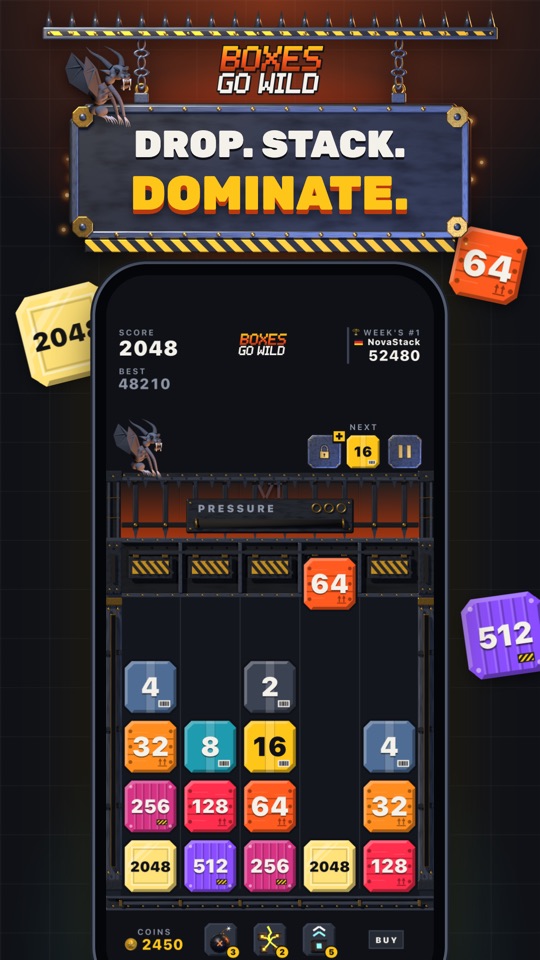
Falling blocks and sliding tiles compared
Number merge puzzles come in two main kinds. In sliding puzzles such as the classic 2048, you swipe and every tile slides at once. In falling block puzzles you place one block and nothing else moves until it lands. The merging is the same; the way you think is not.
| Sliding number puzzle | Falling block number puzzle | |
|---|---|---|
| Your move | Swipe: every tile on the board moves | Tap a column: one block falls |
| New blocks | Appear in a random empty cell after each move | Come from above; you choose where they go |
| What you plan | Which direction keeps the board in order | Where each block lands and which merges it starts |
| Chains | Each tile merges at most once per swipe | One block can set off several merges in a row |
| Game over | No swipe can move any tile | A column fills up |
If you like sliding puzzles for the slow build towards one big tile, falling block puzzles keep that goal and add precise placement: every move is one decision about one block.
How a chain reaction works
A chain is several merges from a single move. Picture a column holding, from the bottom, 64, 32, 16 and 8, with an 8 waiting in the launcher:
- The 8 lands on the 8 and they merge into a 16.
- That 16 now touches the 16 below and merges into a 32.
- The 32 meets the 32 and makes a 64.
- The 64 meets the 64 and makes a 128.
Four merges from one tap. In Boxes Go Wild every step of a chain scores more than the one before (×1, ×1.5, ×2, ×2.5 and so on), so building these staircases is the heart of the game. The tips show how to set them up.
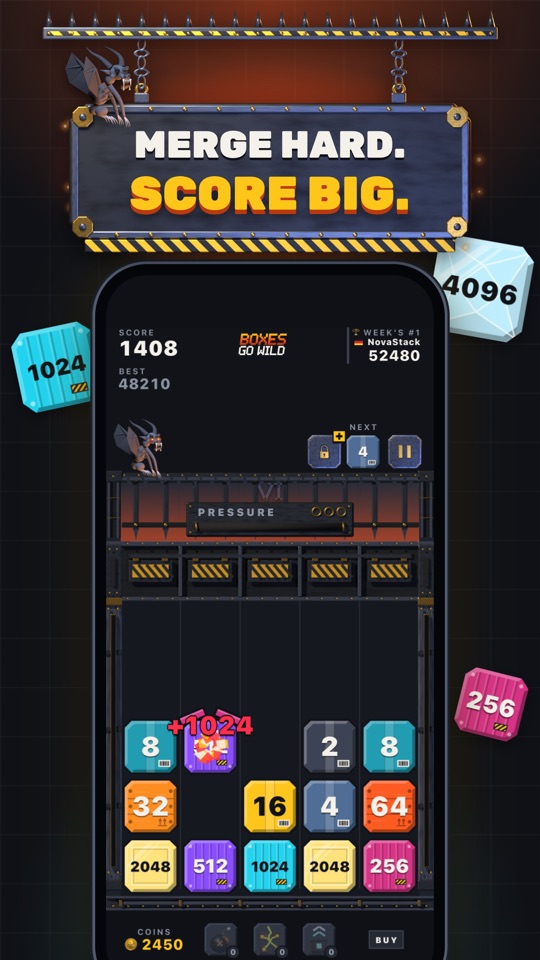
What Boxes Go Wild adds
The tap-and-merge core is familiar. Around it, Boxes Go Wild adds its own systems:
- WILD LIFT. Every game starts with only three rows. Your score lifts the board at 60, 600 and 4,000 points, up to six rows.
- STEAM BLAST. At full height your points build steam; release it to clear the whole bottom row, up to twice a game.
- Steel and cursed crates. From 512 on, steel crates never merge but break after two merges next to them, and cursed crates arrive in chains and are freed at double their value.
- WILD RUSH. Long chains fill a gauge; when it is full, every point is doubled for 10 drops.
- The gothic machine. A gargoyle, a bell tower and an announcer react to how you play.
- WILD RANKS. A world leaderboard and a weekly one that starts fresh every Monday at 00:00 UTC.
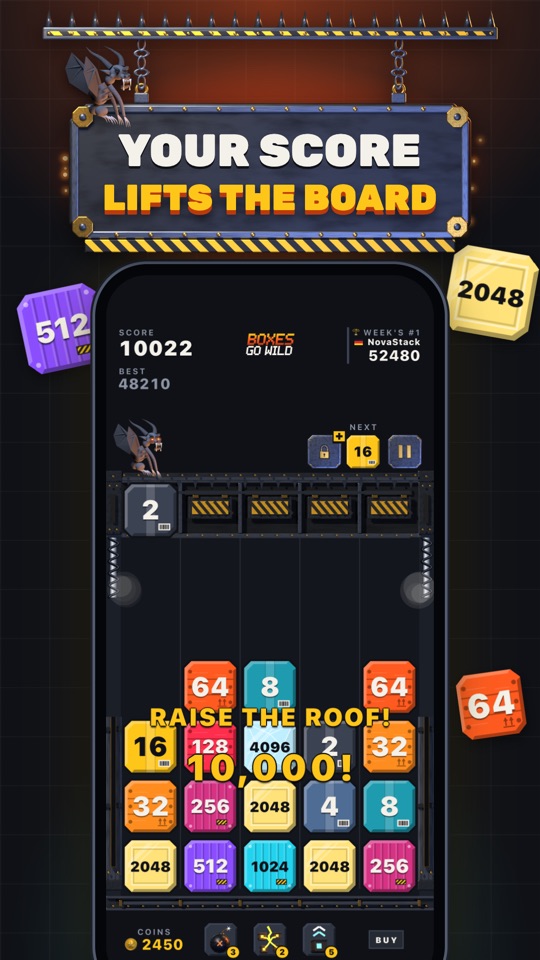
Who will enjoy it
- Players who like one clear goal per move: keep the columns low and chain the merges.
- Anyone who wants to play offline: the whole game works without internet; only live leaderboards, ads and purchases need a connection.
- Players who like to compete, on the world board or the weekly one.
Read the full rules, then learn when to use each booster.
Get Boxes Go WildLast updated 25 October 2026; checked against version 1.0.2.